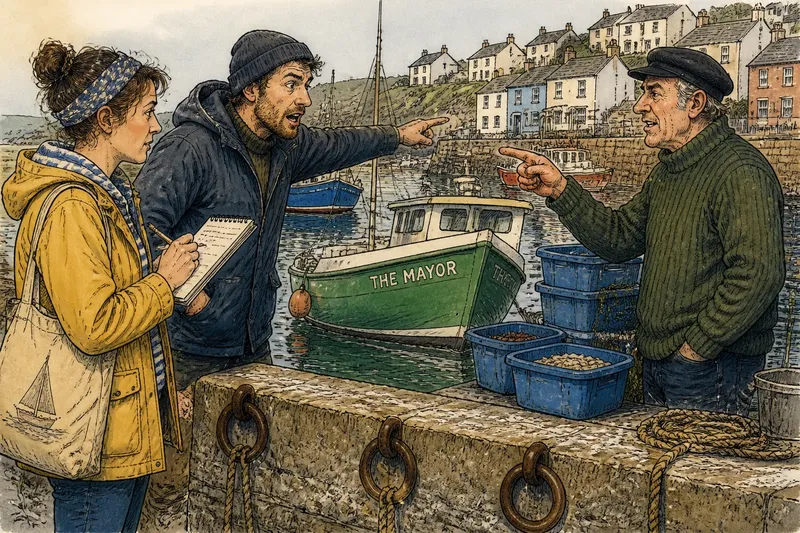
The Local Character Is More Than an Accent
Build a local character beyond an accent by giving them seaside routines, loyalties, and comic speech choices that make their voice feel specific and human.
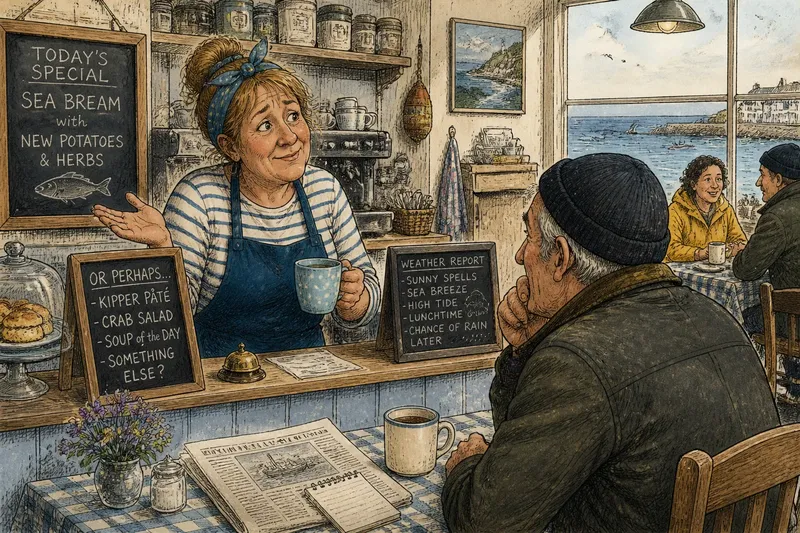
A local character in coastal comedy needs more than an accent: their voice should reveal how they handle a particular person or problem. A café owner who answers an awkward question with an offer of tea can be funny because of that evasive instinct, not because the audience is asked to laugh at how they speak.
Imagine an invented seaside café scene. Its owner is trying to announce that the lunch special has run out, but keeps softening the news until the explanation becomes more confusing than the shortage. The scene’s comic voice can grow from the owner’s chosen tactics, their audience, and the practical vocabulary of the café.
Voice and intention
Start with what the character wants from a conversation. An owner might want a regular to feel welcome, a visitor to stop asking about the chalkboard menu, or a supplier to hear that a delivery is late without taking offense. Those aims shape pauses, evasions, bluntness, and jokes before any dialect detail enters.
Give the character a pattern the reader can recognize. Perhaps they answer complaints with a cheerful suggestion, or turn every question into a story about the weather. The pattern becomes comic when it helps in one moment and makes another more awkward.
Language from the job
Work gives dialogue a useful vocabulary and rhythm. A fishmonger may talk in terms of what arrived and what needs using; a ferry worker may be precise about departure notices; a café owner may keep one eye on orders while speaking. These are possibilities for individual characters, not rules about everyone in a trade or town.
Choose concrete words that belong to the character’s task, then let the scene decide how often they appear. A line about a damp menu or a queue at the counter can feel rooted in a seaside café without turning every sentence into a coastal reference.
Relationships change speech
People rarely speak in exactly the same way to everyone. A character may be brisk with a supplier, teasing with a sibling, and careful with a first-time visitor. That variation makes the voice feel social rather than like a fixed performance.
Let relationships determine what can go unsaid. Two coworkers may understand a glance toward the empty pastry tray, while a visitor needs a plain explanation. The difference gives the dialogue texture and lets the reader see who shares history.
Dialect with care
A specific dialect can add texture, but scattered spellings and catchphrases often reduce a character to an impression. If dialect matters to the story, listen closely to speakers in context and seek informed feedback. Pay attention to how voice changes with age, familiarity, mood, and situation.
Keep the words readable and let syntax, vocabulary, and timing do some of the work. A character’s speech should still make sense on the page when the reader does not know the place personally.
Reworking a comic exchange
In the invented café scene, the starting point is simple: the special has run out, and a regular asks for it. The owner wants to avoid disappointing them, so first says, “We’re just making room for something else,” then offers a different dish, then admits the original item is gone. Each attempt makes the message less direct; the regular finally laughs and orders the alternative.
The result is a small comic exchange built from the owner’s tactful evasions and the regular’s familiarity with them. The words do not need to imitate a whole community. They reveal one person trying to be kind and making a simple answer unnecessarily elaborate.
Dialogue questions?
Can an accent be part of the joke?
It can be part of a character’s voice, but the joke should come from intention, timing, or a relationship rather than from treating the accent itself as the punchline. Keep the speaker’s perspective distinct from a broad imitation of a town.
How do I make local speech sound specific?
Use the character’s work, relationships, and conversational habits to shape word choice and rhythm. A precise exchange between two people often sounds more particular than a string of local names or catchphrases.
How much dialect should I write?
Use only the features that help readers hear the speaker without slowing comprehension. For a real dialect, seek informed feedback and avoid assuming that one person’s speech represents everyone in the area.
How can visitors take part in the humor?
Give visitors their own point of view and let them respond with judgment, curiosity, or patience. Their unfamiliarity can bring a local character’s habits into focus without making the visitor a fool.
Dialogue revision checks
- Check whether a line reveals what the speaker wants; if it does, keep it, and if it only signals “local,” rewrite it around an intention.
- Check whether the character’s job affects their vocabulary; if it does, retain the useful terms, and if it does not, replace generic work jargon with words tied to the scene.
- Check whether the speaker sounds different with a friend and a stranger; if the distinction fits their relationship, keep it, and if both exchanges sound identical, adjust their directness or formality.
- Check whether a dialect spelling slows the line; if the meaning stays clear, keep the light touch, and if the reader must decode it, use standard spelling and shape the rhythm instead.
- Check whether the comic beat depends on an accent being mocked; if it depends on a choice or misunderstanding, keep that beat, and if the accent is the whole joke, rebuild the exchange.
- Check whether a local reference changes what the characters say or understand; if it does, keep it, and if it is only decoration, cut it or save it for a moment where it matters.
A strong local character’s voice comes from the way they speak to particular people while pursuing a particular aim. For coastal comedy, let the language carry the character’s habits and point of view; the seaside setting can emerge in the details that naturally belong in their conversation.