A Rainy Seaside Afternoon Told in Three Scenes
Build a rainy seaside afternoon story around harbor routines, a borrowed noticeboard and a local custom, so each scene advances the comic plot.
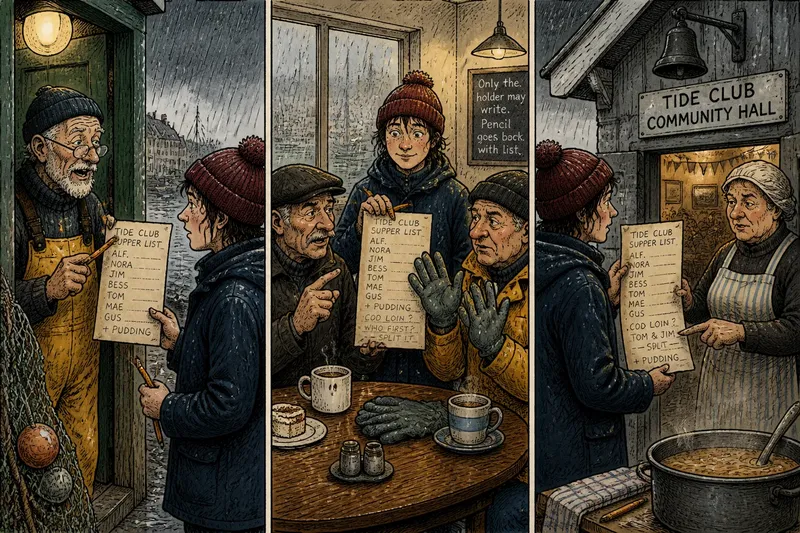
A rainy seaside afternoon story becomes specific when the trouble grows from the town’s own habits. Rather than send a character on a generic errand that rain merely delays, give them a small job bound to a local ritual: carrying the handwritten tide-club supper list from the fish quay to the community hall before the bell that opens the meal.
The three scenes can follow the list from a quay-side doorway to a harbor café and then to the hall’s covered entrance. The joke comes from the community’s elaborate, entirely ordinary way of handling one piece of paper—not from a random mishap or a string of weather gags.
Build around local custom
Choose a routine that could plausibly belong to this fictional town: a supper list passed between regulars, a bell rung before a communal meal, or a rule that the person carrying the list must collect additions in pencil. Make the custom clear through what people do, not through a block of explanation.
The central character needs a modest aim, such as delivering the list with everyone’s supper choice recorded. A particular custom supplies the friction: only the current holder may write on it, so each person who adds a choice must first locate the holder and return the pencil.
Keep the tradition invented and internally consistent. If the reader can see who holds the list, what counts as a valid addition, and why the character keeps moving, the comic complications feel rooted in the place rather than assembled for convenience.
Give each scene a job
At the quay doorway, the character collects the list from a retired net-mender who insists on reading every name aloud. At the café, a regular wants to add a dish but refuses to write while wearing damp gloves. At the hall entrance, the list’s holder must decide whether a late addition belongs before or after the bell.
Each stop should change the list or the character’s understanding of the custom. A scene that only describes rain, harbor smells, or colorful locals may be charming, but it will not carry the story forward unless a character responds to those details.
Give the locations distinct practical roles. The doorway is where the list changes hands, the café is where a new choice creates a disagreement, and the hall entrance is where the town’s rule must be applied. The weather can affect how people handle the paper, but it should not be the main engine of the plot.
Let the list cause trouble
A handwritten list is useful because it can carry visible evidence of each scene. A crossed-out name, a penciled note in the margin, or an addition squeezed between two lines gives the reader something concrete to track.
Use small disagreements that reveal the custom’s social logic. One regular may say an addition counts only if the holder hears it; another may insist that a spoken choice is enough. The character carrying the list has to keep the peace while deciding which version will get supper served on time.
Imagine a fictional harbor town where the supper list is passed from the quay to the hall, and only its holder may approve changes. The protagonist begins with a clean list and a blunt pencil; at the café, two neighbors request the same last portion and disagree about whose name should go first. The protagonist writes both names with a note to split it, then reaches the hall to find that the cook interprets the note as two separate portions; the observable result is a fresh dispute, but the protagonist can resolve it by asking the neighbors to share and marking the list clearly.
Keep the comic stakes local
The story does not need a lost parcel, a sudden emergency, or a stranger with a secret. Let the stakes stay within the custom: will the list be legible, will the late choice be accepted, and can the protagonist hand over a version that the cook and the regulars read the same way?
Local speech can sharpen the humor, but avoid making every character a caricature. A dry correction, a stubbornly precise rule, or a person who treats the pencil as official equipment can be enough. The warmth comes from recognizing that people care about a small ritual because they care about one another.
What should each scene change?
What belongs in the opening scene?
Show the custom in action and give the protagonist a clear task. The reader should understand who hands over the list and what could go wrong if its entries are unclear.
How can the middle scene advance the plot?
Let someone add a choice or challenge a rule, then make the protagonist respond. The next scene should inherit that specific change rather than reset the list and the disagreement.
What should the last scene resolve?
Resolve the practical question created by the local custom, such as whether a late entry counts or how two people can share a dish. Leave room for a small comic echo, like the cook asking who has custody of the pencil.
How much weather detail is useful?
Use rain when it affects an action tied to the story, such as keeping the ink from running or making the doorway crowded. If it does not alter the custom, the list, or a character’s choice, it can stay in the background.
Check the story chain
Before polishing the dialogue, check the working parts of the fictional custom. Each observation points to a decision, with an alternative if the scene does not yet work.
- Custom: If the reader can tell who holds the list and how changes are approved, keep the rule; if not, show a handoff and one accepted entry before adding complications.
- Opening task: If the protagonist’s aim is clear, let the first interruption challenge it; if not, give them a concrete delivery or decision to complete.
- Quay scene: If the first stop changes a name, rule, or expectation, carry that change forward; if it only supplies atmosphere, make someone hand over or amend the list.
- Café scene: If the disagreement affects the supper choices, let it shape the next stop; if it can be removed without changing anything, replace it with a custom-specific dispute.
- Paper trail: If the reader can see what changed on the list, keep the mark or note; if the change is hard to follow, make the entry or crossing-out explicit.
- Hall decision: If the cook and the protagonist can act on the same clear version, resolve the custom; if they read it differently, let the protagonist clarify the disputed entry.
- Comic ending: If the final joke grows from the list or its rules, use it as the closing turn; if it depends on a new accident, end on the consequences of the existing disagreement instead.
A rainy seaside afternoon story feels earned when its three scenes pass along a local custom as well as a physical object. Keep the list, its rules, and the neighbors’ choices in motion, and the comedy will belong to this particular town.